Why Traceable Calibration Is Important for Industries?
What Is Traceable Calibration?
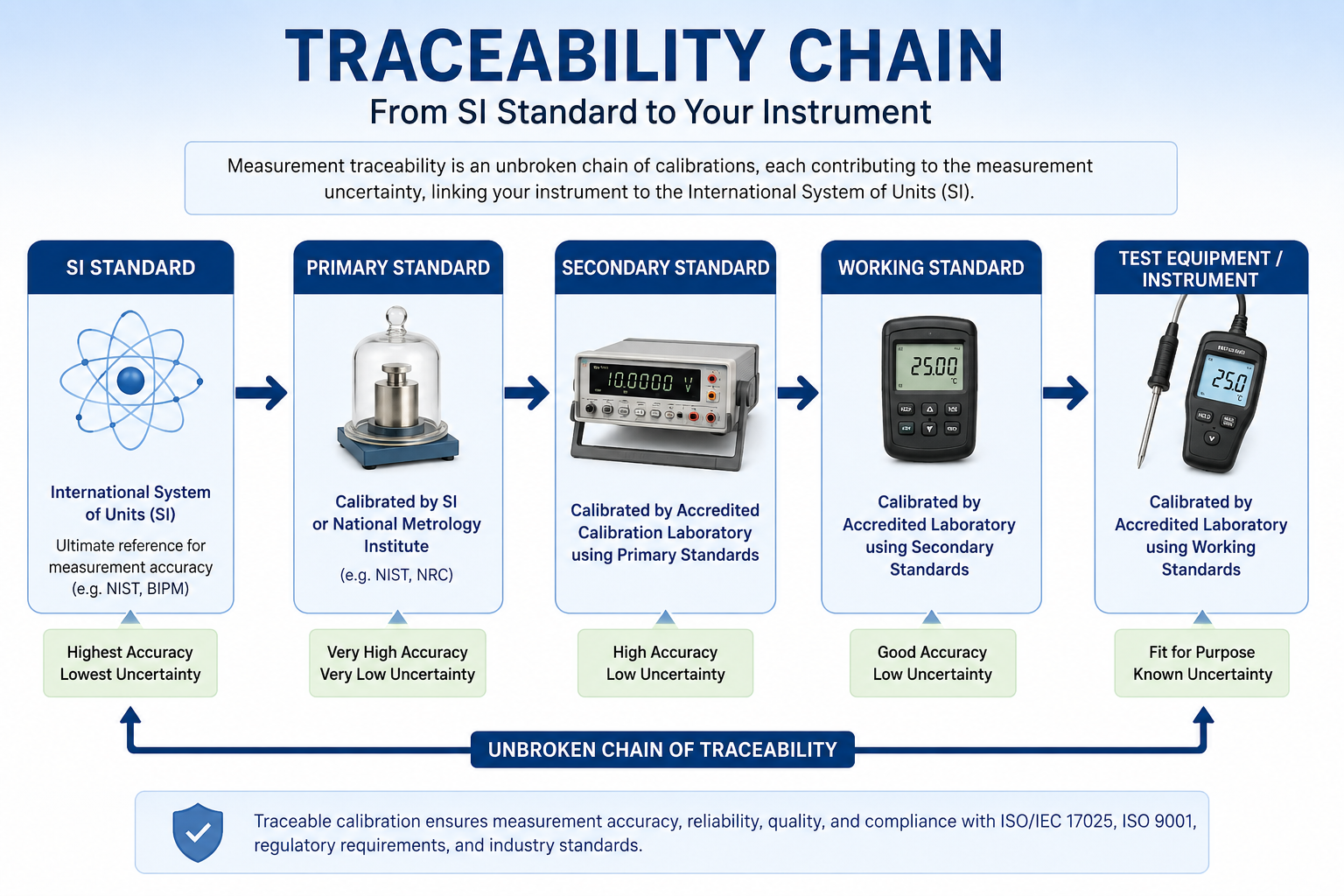
Traceable calibration is the process of comparing a measuring instrument against a reference standard that has an unbroken chain of calibrations leading back to recognized national or international measurement standards, such as:
- National Institute of Standards and Technology (NIST)
- National Research Council Canada (NRC)
- Other internationally recognized metrology institutes
Each calibration in the traceability chain includes documented measurement uncertainty, ensuring confidence in the instrument's accuracy.
A professional traceable calibration certificate typically includes:
- Instrument identification
- Calibration date
- Calibration due date
- Reference standards used
- Measurement results
- Measurement uncertainty
- Environmental conditions
- Traceability statement
- Technician authorization
Why Is Traceable Calibration Important?
1. Improves Measurement Accuracy
Every measuring instrument changes over time due to:
- Normal wear
- Mechanical shock
- Temperature changes
- Humidity
- Transportation
- Aging of electronic components
- Continuous operation
Without routine calibration, measurement errors gradually increase.
Accurate measurements are essential for:
- Product quality
- Process control
- Laboratory testing
- Manufacturing consistency
- Safety-critical operations
Traceable calibration restores confidence in measurement results.
2. Supports Quality Management Systems
Most quality systems require measuring equipment to be verified and calibrated regularly.
Traceable calibration supports compliance with:
- ISO 9001/17025
- Good Manufacturing Practices (GMP)
- HACCP
- Internal Quality Management Systems
- Customer Quality Requirements
Proper calibration records also make internal and external audits much easier.
3. Reduces Production Errors
A single inaccurate instrument can affect an entire production process.
Examples include:
- Incorrect temperature causing spoiled products
- Pressure gauge errors affecting manufacturing equipment
- Improper pH readings leading to rejected chemical batches
- Incorrect balance measurements resulting in formulation errors
- Faulty humidity measurements affecting product storage
Routine calibration helps identify these problems before they become costly.
4. Increases Product Quality
Consistent measurements produce consistent products.
Traceable calibration helps maintain reliable measurements for:
- Temperature
- Pressure
- Relative Humidity
- Weight
- pH
- Conductivity
- Electrical measurements
- Flow
- Dimensional measurements
Better measurements lead to better product quality and greater customer satisfaction.
5. Supports Regulatory Compliance
Many regulated industries require documented calibration records.
Examples include:
- Pharmaceutical manufacturing
- Biotechnology
- Food processing
- Medical device manufacturing
- Healthcare laboratories
- Environmental laboratories
Traceable calibration demonstrates that measuring equipment is maintained according to recognized standards and is suitable for its intended use.
6. Reduces Operational Costs
Routine calibration helps prevent:
- Product recalls
- Rework
- Equipment damage
- Production downtime
- Customer complaints
- Investigation costs
- Regulatory observations
Investing in preventive calibration is often far less expensive than correcting the consequences of inaccurate measurements.
7. Builds Customer Confidence
Many customers request calibration certificates before approving suppliers or accepting products.
Traceable calibration demonstrates:
- Commitment to quality
- Reliable measurement practices
- Consistent manufacturing processes
- Professional quality management
It strengthens supplier credibility and helps maintain long-term customer relationships.
Industries That Require Traceable Calibration
Traceable calibration is essential in many sectors, including:
- Pharmaceutical Manufacturing
- Biotechnology
- Food & Beverage Processing
- Chemical Manufacturing
- Automotive Industry
- Aerospace
- Electronics Manufacturing
- Medical Device Manufacturing
- Hospitals
- Research Laboratories
- Universities
- Environmental Testing Laboratories
- Warehousing and Cold Chain Logistics
- HVAC Services
- Industrial Manufacturing
- Oil & Gas
- Energy Utilities
Instruments Commonly Requiring Traceable Calibration
Many instruments benefit from regular calibration, including:
Temperature Instruments
- Digital Thermometers
- RTD Sensors
- Thermocouples
- Temperature Data Loggers
- Infrared Thermometers
Pressure Instruments
- Pressure Gauges
- Pressure Transmitters
- Vacuum Gauges
- Differential Pressure Gauges
Laboratory Instruments
- Analytical Balances
- Precision Balances
- pH Meters
- Conductivity Meters
- Dissolved Oxygen Meters
Environmental Instruments
- Temperature & Humidity Meters
- Hygrometers
- Data Loggers
Electrical Instruments
- Digital Multimeters
- Clamp Meters
- Power Supplies
- Insulation Testers
Process Instruments
- Flow Meters
- Timers
- Lux Meters
- Sound Level Meters
- Pipettes
How Often Should Instruments Be Calibrated?
Calibration frequency depends on several factors:
- Manufacturer recommendations
- Frequency of use
- Criticality of the measurement
- Environmental conditions
- Industry regulations
- Historical calibration results
For many industrial applications, calibration is performed every 6 to 12 months, although critical instruments may require shorter intervals.
Choosing a Professional Calibration Service Provider
When selecting a calibration service provider, look for:
- Traceable reference standards
- Experienced calibration technicians
- Comprehensive calibration certificates
- On-site and laboratory calibration services
- Fast turnaround times
- Preventive calibration scheduling
- Quality-focused procedures
A trusted calibration partner helps ensure your instruments remain accurate and your operations remain compliant.
Benefits of Working with Euclid Solutions
At Euclid Solutions, we provide professional traceable calibration services for industrial, laboratory, healthcare, pharmaceutical, food processing, and manufacturing facilities.
Our calibration capabilities include:
- Temperature Calibration
- Pressure Calibration
- Relative Humidity Calibration
- pH Meter Calibration
- Conductivity Meter Calibration
- Balance Calibration
- Electrical Instrument Calibration
- Flow Instrument Calibration
- Timer & Stopwatch Calibration
- Lux Meter Calibration
- Sound Level Meter Calibration
- On-Site Calibration Services
- Preventive Calibration Programs
Every service includes detailed documentation to support your quality management system and measurement reliability.
Conclusion
Traceable calibration is more than a routine maintenance task—it is an investment in quality, safety, and operational excellence. Accurate measurements help prevent costly errors, improve process consistency, support regulatory compliance, and build confidence in your products and services.
Whether you operate a manufacturing facility, laboratory, healthcare institution, or warehouse, maintaining a regular calibration program is essential for long-term success.
If you're looking for reliable traceable calibration services, Euclid Solutions is ready to help with accurate, dependable, and professionally documented calibration solutions tailored to your operational needs.