The Importance of Slope Percentage Calculation in pH Meter Calibration
What is pH Electrode Slope?
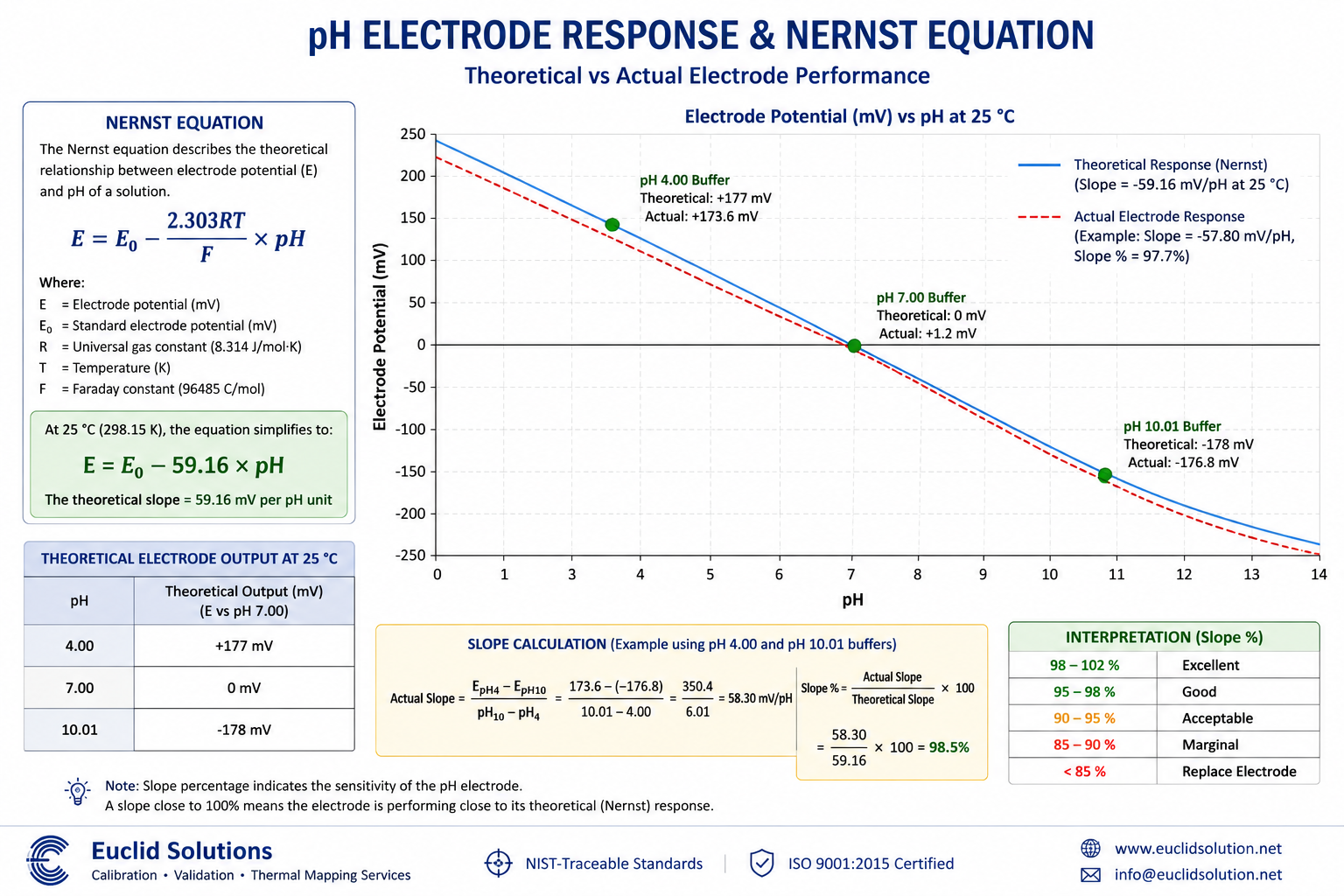
A pH electrode measures the hydrogen ion activity of a solution by generating a small electrical potential (millivolts). According to electrochemical principles, this voltage changes linearly with pH.
The sensitivity of the electrode is known as its slope.
An ideal pH electrode follows the Nernst Equation, producing approximately 59.16 mV per pH unit at 25°C.
The Nernst Equation
The Nernst Equation describes the theoretical relationship between electrode potential and pH.
Where:
- E = Measured electrode potential (mV)
- E₀ = Standard electrode potential
- R = Universal gas constant (8.314 J/mol·K)
- T = Temperature (Kelvin)
- F = Faraday constant (96485 C/mol)
At 25°C, the equation simplifies to:
This is referred to as the theoretical Nernst slope.
Theoretical Electrode Response
At 25°C, the theoretical millivolt output is approximately:
| Buffer Solution | Ideal Electrode Output |
|---|---|
| pH 4.00 | +177 mV |
| pH 7.00 | 0 mV |
| pH 10.01 | -178 mV |
The electrode should produce a nearly straight-line response between these calibration points.
How is Slope Percentage Calculated?
The actual slope is calculated from the measured electrode voltages obtained during calibration.
The slope percentage is then calculated as:
Example Calculation
Measured values:
| Buffer | Measured Voltage |
|---|---|
| pH 4.00 | +176.2 mV |
| pH 7.00 | +1.8 mV |
Actual slope:
Slope percentage:
Therefore,
Electrode Slope = 98.3%
Interpretation of Slope Percentage
| Slope (%) | Condition |
|---|---|
| 98–102% | Excellent |
| 95–98% | Good |
| 90–95% | Acceptable |
| 85–90% | Marginal |
| Below 85% | Replace electrode |
Most laboratories consider an electrode acceptable when the slope is approximately 95–102%, although acceptance limits may vary depending on manufacturer recommendations and application requirements.
Why Does Slope Decrease?
As a pH electrode ages, the glass membrane gradually loses sensitivity.
Common causes include:
- Glass membrane aging
- Protein contamination
- Chemical fouling
- Dehydration
- Junction blockage
- Improper storage
- Mechanical damage
These conditions reduce electrode response and lower the slope percentage.
Why is Slope Percentage Important?
Monitoring slope percentage helps to:
- Verify electrode performance
- Detect aging electrodes
- Identify contamination
- Improve measurement accuracy
- Reduce calibration failures
- Support ISO 17025 and GMP documentation
- Increase confidence in analytical results
Slope percentage is often one of the first parameters reviewed during laboratory troubleshooting.
Three-Point Calibration
Professional pH calibration normally uses:
- pH 4.00
- pH 7.00
- pH 10.01
These buffers verify:
- Zero Offset
- Electrode Slope
- Measurement Linearity
Using three calibration points provides greater confidence across the measurement range than a two-point calibration.
Factors Affecting Electrode Slope
Several variables influence the measured slope:
- Temperature
- Buffer quality
- Electrode cleanliness
- Electrode age
- Calibration procedure
- Instrument stability
Temperature compensation is particularly important because the theoretical Nernst slope changes with temperature.
Nernst Slope vs Temperature
| Temperature | Theoretical Slope |
|---|---|
| 0°C | 54.20 mV/pH |
| 10°C | 56.18 mV/pH |
| 20°C | 58.17 mV/pH |
| 25°C | 59.16 mV/pH |
| 30°C | 60.15 mV/pH |
| 40°C | 62.14 mV/pH |
| 50°C | 64.12 mV/pH |
This is why automatic temperature compensation (ATC) is recommended during calibration and measurement.
Professional pH Calibration Services
At Euclid Solutions, our pH meter calibration services include:
- Multi-point pH calibration
- Slope percentage calculation
- Electrode offset verification
- Nernst slope evaluation
- Accuracy assessment
- Measurement uncertainty evaluation
- Calibration certificates
- NIST-traceable reference buffer solutions
- ISO 9001:2015 Certified Quality Management System
We calibrate:
- Bench-top pH meters
- Portable pH meters
- Process pH analyzers
- Laboratory pH systems
- Industrial pH transmitters
Conclusion
The slope percentage is one of the most important indicators of pH electrode performance. By comparing the measured electrode response with the theoretical Nernst response, laboratories can quickly determine whether an electrode remains suitable for accurate measurements.
Routine slope evaluation not only improves confidence in pH measurements but also supports regulatory compliance, quality assurance, and preventive maintenance programs. For organizations operating under GMP, GLP, ISO 9001, or ISO/IEC 17025, documenting electrode slope is an essential part of a robust calibration program.
Why Choose Euclid Solutions?
Euclid Solutions provides professional calibration services for pH meters and laboratory instruments using NIST-traceable reference standards and an ISO 9001:2015 Certified Quality Management System.
We proudly serve the pharmaceutical, food & beverage, healthcare, environmental, biotechnology, and research sectors across Toronto, the GTA, and Canada.
🌐 www.euclidsolution.net
📧 info@euclidsolution.net
Precision. Compliance. Trust.